
Case Study · Manufacturing
From invisible
to in-pipeline.
How a custom cable assembly manufacturer built a marketing engine that closed $500K+ in business in a single year.


Industry
Electronics Manufacturing
Services
CRM · Email · Social · SEO & Content · Web
Engagement
Full-Service Digital Marketing Partnership
The Results — At a Glance

Closed Business
$500K+
Directly attributed to marketing activity

Time to Results
From engagement start to attributed
revenue

Channels Integrated
5
CRM · Email Marketing · Social Media · SEO & Content · Web

Attribution
100%
Every deal traceable back to source
The Situation
marketing as an afterthought
For many manufacturers, marketing is an afterthought. The product speaks for itself, the sales team handles relationships, and digital presence is something that gets addressed when there’s time. For this custom cable assembly manufacturer, that approach had worked well enough for years. But as competition increased and buyers started doing more research before ever picking up the phone, “well enough” stopped being sufficient.
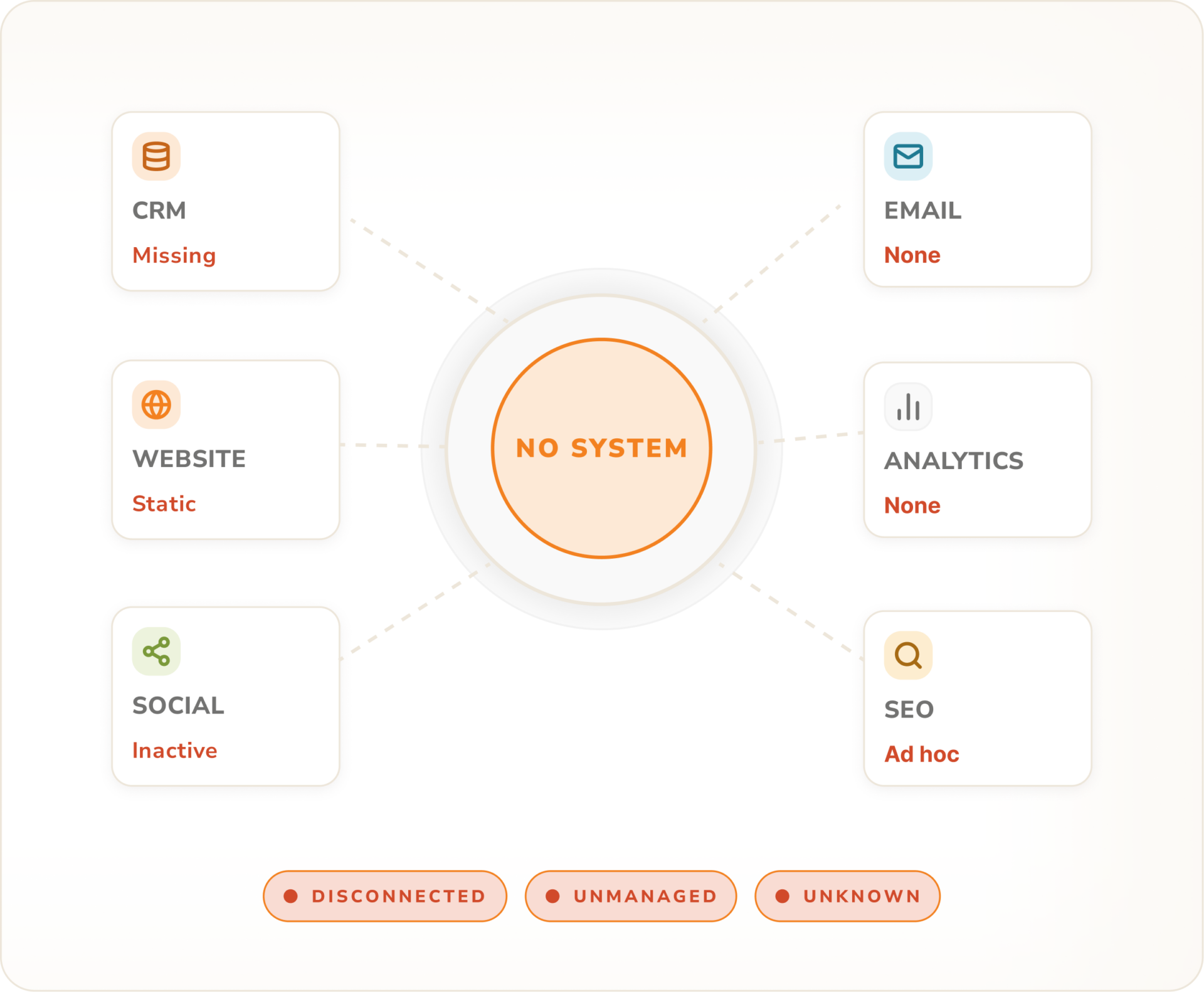
When they came to IMG, they had no consistent marketing activity, no way to track where leads were coming from, and no system connecting their sales team to their marketing efforts. They were generating some business, but had no visibility into what was driving it or how to replicate it. Growth felt more like luck than strategy.
They needed more than a vendor. They needed a partner who could build the infrastructure, execute consistently across channels, and connect marketing activity to actual pipeline.
The Approach
foundation first, then execution
IMG’s first priority was building the foundation before running any campaigns. Without a reliable system to track leads, attribute revenue, and qualify prospects, any marketing activity would be difficult to measure and harder to scale.
That meant starting with CRM implementation. IMG configured a full pipeline tracking system in HubSpot that connected inbound leads directly to the sales process, giving the team visibility into where every opportunity came from and where it stood. Lead qualification criteria were built into the system so sales could prioritize effectively instead of chasing contacts with no context.
With the infrastructure in place, IMG launched a coordinated presence across the channels that matter most for a B2B manufacturer: email marketing to nurture existing contacts and re-engage dormant ones, social media to build consistent brand visibility with the right industrial audience, and an ongoing content and SEO program to make the company findable when buyers were actively searching for cable assembly solutions.
Nothing operated in isolation. The content strategy fed the email program. The email program drove traffic back to the website. The CRM tracked every conversion point so the sales team always knew which marketing touchpoints were producing qualified conversations.

01 / Foundation
CRM Implementation

02 / Nurture
Email Marketing

03 / Visibility
Social Media

04 / Findability
SEO & Content

05 / Home Base
Web Presence
What Changed
A year in, the infrastructure matched the ambition.
A year into the partnership, the results reflected what happens when marketing infrastructure and consistent execution work together.
The company now has a fully operational CRM that gives leadership and sales complete visibility into pipeline, lead source, and deal status. For an organization that previously had no system in place, that alone changed how decisions get made.
More importantly, over $500,000 in closed business has been directly attributed to digital marketing activity. Not influenced by, not loosely connected to. Attributed. That number represents real contracts from buyers who entered the pipeline through the marketing channels IMG built and managed.
Beyond revenue, the company has established a consistent and credible online presence it did not have before. Regular content keeps the website relevant and searchable. Social media keeps the brand visible between sales conversations. Email marketing keeps existing contacts engaged and opens doors for upsell and referral conversations that might otherwise never happen.

Growth felt like luck.

No CRM. No visibility into pipeline or lead source.
Sales chasing contacts with no qualification context.
Ad-hoc digital activity. No attribution to revenue.
Site quiet between sales conversations. Brand invisible.
Every deal traces back.

Fully operational HubSpot CRM.
Lead qualification built into the system. Sales prioritizes with context.
Every conversion point tracked. $500K+ attributed, not guessed.
Consistent, credible online presence. Brand visible in-between converstations.
Why it Worked
Integration, not just execution.
The most common reason full-service marketing engagements underperform is fragmentation. Strategy goes one direction, execution goes another, and the sales team is left working with leads that marketing never properly qualified. There is no shared system, no shared language, and no clear accountability for outcomes.
This engagement worked because IMG built the system and ran it. The CRM implementation was not handed off to the client to figure out after go-live. The content strategy was not a document that sat in a folder. Every piece of the program was built to connect to the next one, and IMG stayed accountable for the results across all of it.
For a manufacturer entering the digital marketing space for the first time, that kind of integrated execution was the difference between building something that produced results and spending money on activity that went nowhere.

Built the system. Then ran it.
The CRM implementation was not handed off to the client to figure out after go-live. IMG owned the setup and the ongoing operation.
Every piece connected to the
next.
Content drove traffic. Traffic became leads. Leads flowed into the CRM. The flywheel was designed, not accidental.
One partner accountable for the outcome.
Not five vendors with different scorecards. One partner responsible across strategy, execution, and reporting.
The Takeaway
A year in, this custom cable assembly manufacturer has a marketing function that did not exist before, a sales team with better pipeline visibility than they have ever had, and half a million dollars in closed business they can trace directly back to that investment.
That is what a full-service marketing partnership is supposed to produce.
The Takeaway
Ready to see what an integrated marketing program could do for your business?
Let’s talk about where you are and what it would take to build something that actually moves the needle.
